Intensive vs Extensive Aquaculture: Key Differences & Sustainability
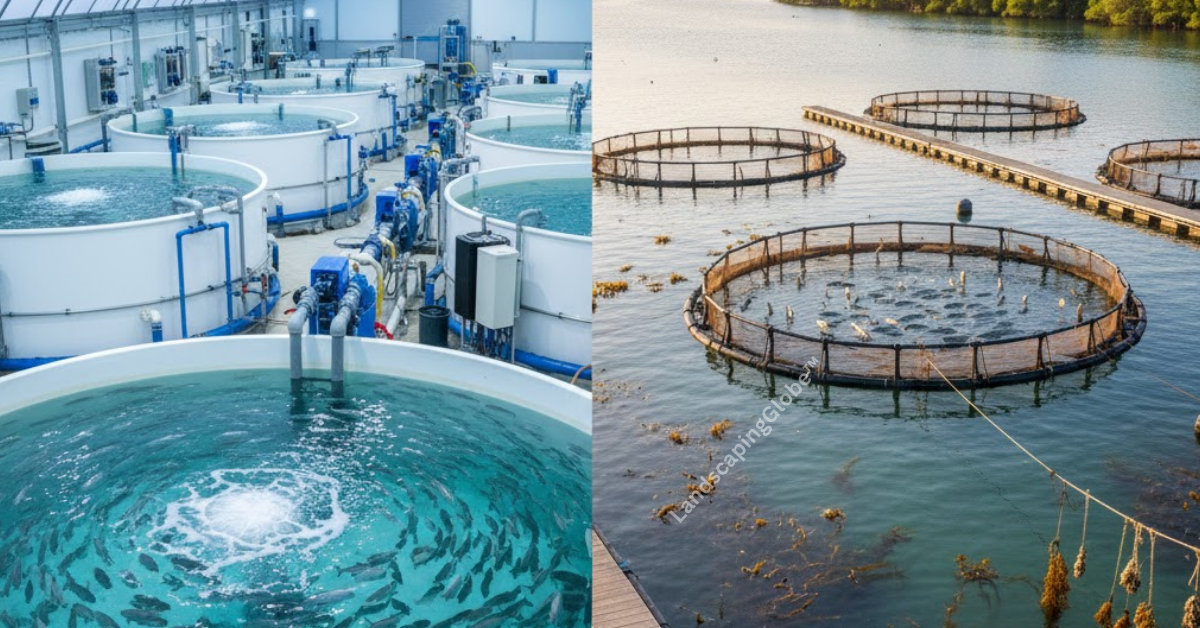
Aquaculture is the controlled breeding, rearing, and harvesting of aquatic organisms, including fish, shellfish, and plants. It happens in freshwater, marine, or brackish environments. Imagine turning water into a farm. Yes, it’s literally fish farming! This method provides over 50% of the world’s seafood, which is amazing because wild stocks cannot meet growing demand.
Common systems include ponds, floating net pens, raceways, and Recirculating Aquaculture Systems (RAS). Each system solves problems differently: RAS recycles water, ponds hold natural fish populations, and net pens protect fish from predators. Types of aquaculture include marine aquaculture (mariculture), like salmon and oysters, freshwater aquaculture, like catfish and trout, and brackish aquaculture, mixing salt and freshwater.
Farmers also grow aquatic plants like seaweed and kelp, providing both food and economic opportunities. The benefits are huge: sustainable food production, boosting the economy, and reducing pressure on wild fish stocks. Challenges exist, like controlling diseases, managing nutrient release, and avoiding habitat alteration. Still, aquaculture is the fastest-growing alternative agriculture and a smart solution for feeding our planet.
What is Intensive & Extensive Aquaculture Farming?
Intensive aquaculture is high-density farming using controlled environments like tanks or raceways with artificial feed and oxygenation. Farmers push production to the maximum, aiming for high efficiency and commercial yield. Imagine filling a tank with trout, eel, salmon, or tilapia, carefully managing every drop of water.
It's hard work but extremely productive! On the other hand, extensive aquaculture relies on low-density, natural ecosystems like ponds or coastal waters, using minimal management and natural food sources. Traditional carp, clam, and oyster farming often use this method, letting nature take most of the control. Semi-intensive farming acts as a middle ground, mixing moderate density with supplemental feeding.
The main differences are clear: density, feed, location, and cost. Intensive systems demand high capital and energy but give predictable results. Extensive systems are cheaper and environmentally friendly but depend heavily on natural conditions. Both systems have advantages and challenges, but together they make aquaculture a flexible, sustainable solution to feeding communities and solving seafood shortages.
Key Differences Between Intensive and Extensive Aquaculture
| Feature | Intensive Aquaculture | Extensive Aquaculture |
| Stocking Density | High density in tanks and cages | Low density in ponds or coastal areas |
| Feed | Artificial feed, managed nutrients | Natural food like plankton |
| Water Management | Aeration, filtration, controlled water | Relies on natural water cycles |
| Production & Cost | High yield, high capital cost | Lower yield, cost-effective, eco-friendly |
| Area Requirement | Small spaces, RAS, net pens | Large ponds, lagoons, coastal waters |
| Growth Rate | Rapid growth, predictable | Slow growth, seasonal |
| Environmental Impact | Risk of nutrient and chemical pollution | Generally eco-friendly |
| Examples | RAS, net pens, tank farming | Oyster farming, carp ponds |
Production Methods Used in Intensive Systems
1. Intensive Crop Production
- Monocropping: Growing a single high-yield crop over large areas. Think of planting only corn or wheat for maximum harvest.
- Mechanization: Using heavy machinery for planting, cultivation, and harvesting to save labor.
- Chemical Inputs: Synthetic fertilizers, herbicides, and pesticides boost growth but require careful handling.
- Irrigation: Precise water supply via pivot irrigation or drip irrigation ensures consistent crop health.
- Genetic Modification & Improved Seeds: Using transgenic seeds or high-yield varieties for faster growth and resistance.
- Techniques: Crop rotation, no-till farming, and vertical farming in urban areas improve efficiency.
Intensive Animal Farming (CAFOs) | Intensive Aquaculture |
| Confinement: Livestock kept in cages, stalls, or feedlots for higher density. | High Density: Raising fish or shrimp in tanks or cages for maximum yield. |
| Controlled Environment: Artificial light, temperature control, and automated feeding/watering systems ensure optimal growth. | Water Management: Aeration, filtration, and water treatment maintain oxygen and remove waste. |
| Accelerated Growth: Use of hormones, antibiotics, and specialized nutrient-rich feed. | Integrated Multi-Trophic Aquaculture (IMTA): Combining species from different trophic levels improves efficiency. |
| Breeding: Forced breeding and artificial insemination increase stock rapidly. | — |
Cost Comparison: Intensive vs Extensive Aquaculture
1. Capital Investment
- Intensive aquaculture requires high capital for RAS, net pens, high-density tanks, and automated feeding systems.
- Extensive aquaculture has low investment, using natural ponds, coastal waters, or lagoons.
2. Operating Costs
- Intensive systems spend more on artificial feed, aeration, water treatment, and labor.
- Extensive systems rely on natural food sources, plankton, and existing water cycles, reducing costs.
3. Production Yield vs Cost
- Intensive aquaculture gives high yields of fish, shrimp, or tilapia, but costs remain high.
- Extensive aquaculture has lower yields (500 kg–2 tons per hectare), but expenses are minimal.
4. Sustainability Costs
- Intensive systems may need waste management, pollution control, and IMTA for efficiency.
- Extensive systems are eco-friendly, relying on natural ecosystems, so sustainability costs are lower.
5. Key Takeaway
- Intensive aquaculture = high cost, high yield, controlled environment.
- Extensive aquaculture = low cost, lower yield, nature-driven growth.
Environmental Impact of Intensive Aquaculture
- Water Pollution: High-density fish farming produces feces and leftover feed, causing algae blooms and dead zones.
- Habitat Destruction: Shrimp farms and coastal aquaculture destroy mangroves and essential coastal habitats.
- Disease Spread: Crowded cages spread pathogens like sea lice, affecting wild fish populations.
- Biodiversity Threat: Chemicals, antibiotics, and escaped fish harm marine life and wild genetic diversity.
- Resource Use: Intensive aquaculture relies on wild fish for feed, using 0.5 tons of wild fish per ton farmed.
- Sediment Contamination: Waste accumulates organic matter and heavy metals (zinc, copper) in benthic environments.
- Solutions / Sustainability: Use IMTA, improved waste management, and disease control to reduce environmental damage.
Environmental Impact of Extensive Aquaculture
- Habitat Loss: Coastal extensive aquaculture destroys mangroves and coastal habitats.
- Water Pollution: Fish waste releases nitrogen and phosphorus, causing algal blooms and dead zones.
- Disease & Genetics: Escaped farmed fish spread diseases, parasites, and alter wild fish populations.
- Chemical Contamination: Antibiotics, pesticides, and disinfectants harm marine life.
- Resource Use: Relies on wild-caught fish for feed, pressuring wild fish stocks.
- Sedimentation: Waste increases organic matter and heavy metals (copper, zinc) in benthic communities.
- Sustainable Options: Bivalve and seaweed farming reduce impact and improve ecosystems.
Profitability and Yield Comparison
Profitability and yield are two key financial measures in agriculture and aquaculture. Profitability, often measured as ROI (return on investment), reflects the total gain after accounting for all costs, while yield indicates the income generated relative to the investment. High yield may not always translate into high profitability, especially if input costs, such as fertilizers, labor, or feed, are high.
For example, a soybean farm may achieve a high yield but realize low net profit due to expensive fertilizers and operational costs. Yield is often used to forecast potential income, whereas profitability provides a backward-looking assessment of actual returns. From an investment perspective, yield is helpful for comparing assets or stocks, while ROI evaluates overall efficiency and financial success.
The key takeaway is that focusing on profit per acre or unit is more effective than merely chasing maximum yield, as a lower yield with controlled costs can be more profitable. Tools like yield efficiency, calculated as income multiplied by selling price minus input costs, can help optimize profitability. Industry variations exist too, with sectors like tech stocks sometimes outperforming traditional high-dividend stocks in total returns.
Water Quality Management Techniques
- Filtration & Sedimentation: Remove solid particles and impurities using sand, gravel, and activated carbon.
- Disinfection: Kill bacteria and pathogens using chlorination, ozonation, or UV light.
- Reverse Osmosis (RO): Membrane-based process for high-purity water, used in wastewater treatment or drinking water production.
- Coagulation & Flocculation: Chemicals aggregate fine particles for easier removal.
- Biological Treatment: Microorganisms break down organic matter in wastewater systems.
- Buffer Zones: Plant vegetation along water bodies to trap pollutants and reduce erosion.
- Agricultural Best Practices: Use cover crops, crop rotation, no-till farming, and nutrient management to minimize runoff.
- Stormwater Management: Implement bioswales, rain gardens, and detention ponds to control runoff in urban areas.
- Erosion Control: Use sediment basins and silt fences to prevent soil from entering waterways.
- Water Quality Monitoring: Regular sampling and trend tracking to compare against standards.
- Regulatory Compliance: Follow Clean Water Act initiatives and Total Maximum Daily Loads (TMDLs).
- Industrial Effluent Control: Monitor and treat industrial discharges, often using closed-loop systems.
Advantages and Disadvantages of Intensive & Extensive Aquaculture
| Feature / Aspect | Intensive Aquaculture | Extensive Aquaculture |
| Stocking Density | Very High (recirculating tank farms, high-density fish culture systems) | Low (natural feed, low-density ponds) |
| Input (Feed/Energy) | High; uses artificial feed, energy-intensive systems | Low; relies on natural food sources, minimal energy input |
| Yield / Productivity | High; year-round production and maximum output (Atlas Scientific) | Low; seasonal and unpredictable yields (Nature-Based Infrastructure Global Resource Centre) |
| Control / Management | Precise control over water quality, diet, disease (Farmers Weekly) | Dependent on natural conditions, limited control |
| Environmental Impact | High; water pollution, disease spread, nutrient accumulation | Low; more sustainable, supports biodiversity (Delve Publishing) |
| Cost / Investment | High; requires capital-intensive technology | Low; minimal investment in infrastructure or feed |
| Suitability | High-value species farming (Bloom Ranch) | Subsistence or high-volume, low-cost seafood production |
| Advantages | High yield, efficient resource use, controlled environment | Sustainable, low cost, promotes biodiversity |
| Disadvantages | Environmental risks, high energy costs, disease susceptibility | Low yield, large land/water requirement, unpredictable output |
Which Aquaculture System is Best for Sustainable Fish Farming?
Recirculating Aquaculture Systems (RAS) are widely regarded as the best option for sustainable fish farming, as noted by USDA, Oceans Research, and The Ocean Foundation. These land-based systems continuously treat and reuse water, minimize effluent discharge, reduce fish escapes, and allow precise control over water quality, disease, and feed efficiency.
Other eco-friendly options include Semi-Closed Containment Systems, polyculture with seaweed, shellfish, and fish, and offshore aquaculture, all of which lower environmental impact. While RAS requires a higher initial investment, its water efficiency, environmental control, and reduced chemical use make it the leading sustainable aquaculture method, outperforming traditional pond or open-cage systems.
Conclusion
Intensive aquaculture increases yield and profitability using high stocking densities, controlled feeding, and technology, but raises environmental risks and operational costs.
Extensive aquaculture relies on natural feed and low-density systems, offering sustainability, lower costs, and biodiversity benefits, though yields are less predictable.
Choosing the best system depends on resources, production goals, and environmental priorities, while hybrid solutions like Recirculating Aquaculture Systems (RAS) balance efficiency and sustainability.
FAQs
1. What is intensive aquaculture farming?
Intensive aquaculture is a high-input, high-density fish farming system that uses artificial feed, aeration, and close monitoring to maximize production.
2. What is extensive aquaculture farming?
Extensive aquaculture relies on natural resources, low stocking density, and minimal human intervention, often using natural ponds or water bodies.
3. What are the main differences between intensive and extensive aquaculture?
The main differences are stocking density, feed usage, labor requirements, environmental impact, and yield. Intensive systems have higher inputs and yield, while extensive systems are low-cost and eco-friendly.
4. Which method is more profitable?
Intensive aquaculture is generally more profitable due to higher production per unit area, but it requires more investment and management.
5. Which system is more environmentally sustainable?
Extensive aquaculture is more sustainable as it uses natural resources with minimal pollution and energy input.
6. What types of fish are suitable for intensive farming?
High-demand species like tilapia, catfish, and shrimp are commonly farmed intensively because they grow quickly and tolerate high density.
7. What types of fish are suitable for extensive farming?
Carp, trout, and native freshwater species are often grown extensively in ponds or lakes with natural feed.